

Ultimate Guide of 10GBase-T Cables
Everything about 10GBase‑T cables: speed, compatibility, and best practices for reliable enterprise and data center connectivity.
10GBASE-T technology offers a robust solution for deploying 10-gigabit Ethernet over conventional copper wiring, extending connectivity up to 100 meters and establishing itself as a highly cost-effective alternative to fiber optic deployments within data centers, enterprise networks, and campus environments. This allows organizations to achieve significant bandwidth upgrades utilizing existing infrastructure paradigms, thereby optimizing capital expenditure and simplifying implementation. Among the available copper cabling options, Cat6a cabling distinguishes itself as the most reliable and balanced choice, providing exceptional performance and signal integrity essential for 10Gbps transmission while ensuring full backward compatibility with previous Ethernet standards. Its superior affordability, combined with its advanced capabilities, positions Cat6a as a strategic and pragmatic investment for evolving network demands.
What Is 10 Gigabit Ethernet? 10 GbE or 10 Gigabit Ethernet is one of the fastest types of ethernet, consisting of a group of networking technologies that transmits data frames at a rate of 10 Gigabit or 10 billion bits every second. It was first specified by the IEEE 803.3ae-2002 standard to define the physical layer (physical connection) and data link layer's media access control (MAC). But along with the continuous adaptation, IEEE 802.3an-2006 finally released the 10GBASE-T standard connection that has been widely used until recent days.
If you’re planning a 10GBASE‑T deployment, prioritize Cat6a cables for reliability and scalability. Cat6 can be used for shorter runs, while Cat7/8 are niche solutions. This approach ensures future‑proofing, cost efficiency, and compatibility with existing RJ45 infrastructure.


Standard: IEEE 802.3an (10 Gigabit Ethernet over twisted‑pair copper).
Medium: Unshielded Twisted Pair (UTP) copper cabling with RJ45 connectors.
Distance: Up to 100 meters with Cat6a cabling.
Speed: 10 Gbps full‑duplex transmission.
Use Cases: Data centers, enterprise LANs, campus networks, and cloud infrastructure where fiber is costly or complex.
As the advancement of technology drives faster ethernet connectivity within industry, 10 Gigabit Ethernet (10 GbE) connections can transmit 10 billion bits of data every second. Put simply, the more bandwidth that is available, there are benefits for faster data transmissions between devices and machines. 10GbE connections provide the IoT applications additional benefits for faster connectivity and lower latency. In addition, the demand for faster Gigabit Ethernet networks continues to fuel the development of high-speed industrial communication infrastructures and data telemetry systems within industrial applications.
There are three types of 10GbE cables that can be chosen from cat6, cat6a, and cat7. This cabling will be in charge of connecting endpoint devices such as PCs, WI-FI access points, and an abundance of IoT devices. Cat6 and Cat6a are the two most common cables, while the cat7 is not as preferable to the two other cables. To explain further, cat7 has a very impressive standard, but it is not an IEEE-based standard and uses a GG45 connector instead of the common RJ-45 ethernet connector. As a result, cat7 cable compatibility has made it hard to be widely used. Cat6 and Cat6a cables are often being compared to each other and are known for their reliable speed. Cat6 can run up to 1000Base-T ethernet at speed up to 1000Mbps to a maximum of 100 meters. But with the 10GbE's 10Gbase-T standard, a cat6 cable can only reach a maximum of 35 to 55 meters, depending on the interference in the environment. As a result, cat6 is not the best when compared to cat6a. Cat6a, on the other side, provides the improved noise-canceling capability and a higher level of Power Over Ethernet (PoE) output while maintaining its performance. PoE is used to deliver power and transmit data towards the endpoint devices. PoE devices are growing exponentially along with the adaptation of IoT. Therefore, cable cat6a is the best choice so far, it allows connection up to 100 meters.

Bandwidth intensive applications are further pushing the threshold on the need for higher performance, making 10G Ethernet an imperative for inter-switch and server-to-switch links. However, a glaring problem facing network managers is the high costs associated with 10G optical cabling, which has delayed widespread adoption of 10G Ethernet. Fortunately, 10GBase-T switch overcomes these cost barriers, ushering in an affordable migration to 10Gb copper switch throughout the data center.
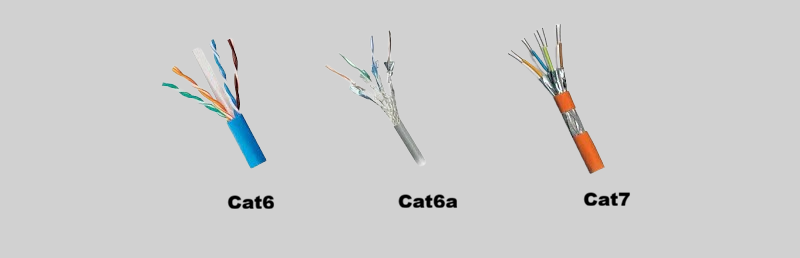
What Type of Cables Do I Need For 10 Gigabit Ethernet?